
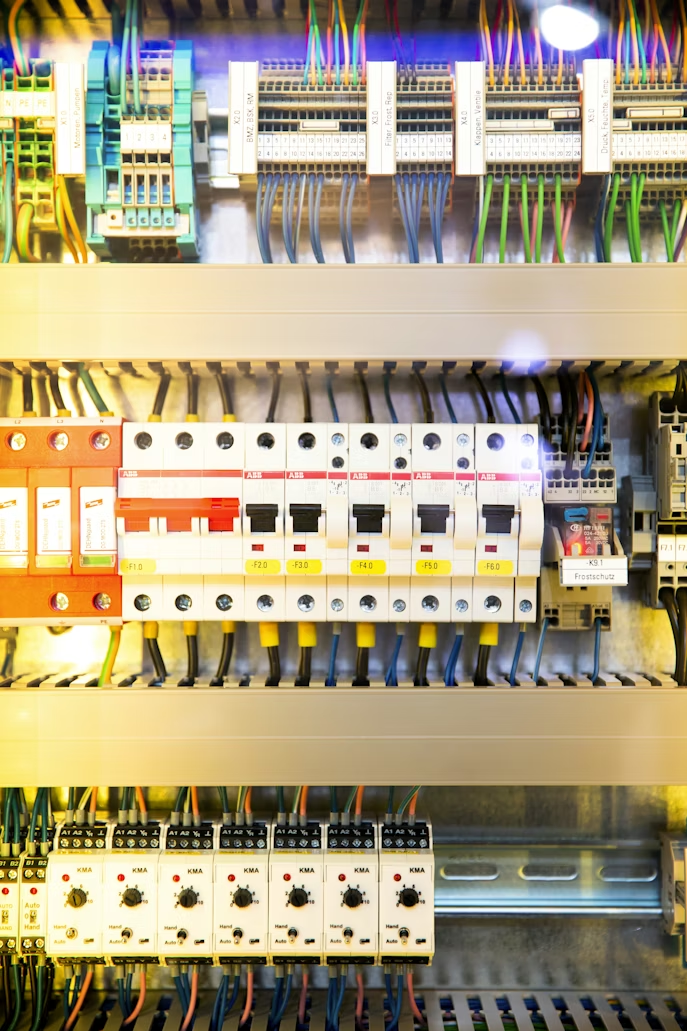
Soft starter vs VFD is a common comparison in industrial motor control. Both devices help control motor starting, but they work in different ways and are used for different applications.
A soft starter is mainly used to reduce starting current and mechanical stress during motor startup. However, a VFD controls both motor starting and motor speed.
Therefore, the correct choice depends on the motor application, process requirement, cost, and maintenance needs.
Soft Starter vs VFD Comparison
Soft starter vs VFD selection is important for pumps, fans, conveyors, compressors, mixers, and other industrial motor applications.
Both devices are used with electric motors. However, they are not the same.
A soft starter provides smooth starting and stopping. A VFD provides smooth starting, stopping, and speed control.
| Item | Soft Starter | VFD |
|---|---|---|
| Main Function | Smooth start and stop | Speed control and motor control |
| Speed Control | No continuous speed control | Full speed control |
| Starting Current | Reduced | Reduced and controlled |
| Mechanical Stress | Reduced | Reduced |
| Energy Saving | Limited | High in variable speed applications |
| Cost | Lower | Higher |
| Complexity | Simpler | More complex |
| Maintenance | Easier | Requires more technical knowledge |
| Best For | Fixed-speed motors | Variable-speed motors |
What Is a Soft Starter?
A soft starter is an electrical device used to start a motor smoothly.
It reduces the voltage supplied to the motor during startup. As a result, the starting current and starting torque are reduced.
After the motor reaches full speed, the soft starter usually allows the motor to run at normal voltage.
Soft starters are commonly used for:
- Pumps
- Fans
- Conveyors
- Compressors
- Blowers
- Crushers
- Mixers
They are useful when the motor does not need speed control during normal operation.
What Is a VFD?
A VFD, or Variable Frequency Drive, is an electrical device used to control motor speed.
It changes the frequency and voltage supplied to the motor. Because of this, the motor speed can be increased or decreased based on process requirements.
A VFD is commonly used when the load requires variable speed.
Examples include:
- Pumps with flow control
- Fans with airflow control
- Conveyors with speed adjustment
- HVAC systems
- Process machines
- Compressors with variable demand
A VFD gives better process control than a soft starter.
Soft Starter vs VFD: Main Difference
The main difference between soft starter vs VFD is speed control.
A soft starter only controls the motor during starting and stopping. After startup, the motor runs at full speed.
A VFD controls the motor during starting, stopping, and normal running.
Therefore, if the motor only needs smooth starting, a soft starter may be enough. However, if the motor needs speed control, a VFD is usually the better option.
Soft Starter vs VFD Starting Current Comparison
Starting current is one of the main reasons for using motor starting equipment.
When an induction motor starts directly online, it may draw high starting current. This can cause voltage drop, electrical stress, and mechanical stress.
A soft starter reduces starting current by gradually increasing voltage.
A VFD also reduces starting current, but it controls frequency and voltage together. Therefore, the starting process is usually smoother and more controlled.
For basic current reduction, a soft starter can work well. For advanced motor control, a VFD is better.
Soft Starter vs VFD Speed Control
Speed control is where the VFD has a major advantage.
A soft starter cannot control motor speed during normal operation. It starts the motor smoothly, then the motor runs at full speed.
A VFD can run the motor at different speeds based on process demand.
For example, a pump may not need to run at full speed all the time. In this case, a VFD can reduce speed and save energy.
So, for fixed-speed operation, use a soft starter. For variable-speed operation, use a VFD.
Soft Starter vs VFD Energy Saving Comparison
Soft starter vs VFD energy saving depends on the application.
A soft starter does not normally save much energy during normal running. Once the motor reaches full speed, the soft starter does not reduce the motor speed.
A VFD can save energy when the motor speed can be reduced.
This is very useful for:
- Pumps
- Fans
- Blowers
- HVAC systems
- Variable flow systems
For constant-speed loads, energy saving from a VFD may be limited. However, for variable torque loads, a VFD can provide significant energy savings.
Soft Starter vs VFD Cost Comparison
Soft starters are usually cheaper than VFDs.
They are simpler, smaller, and easier to install. Also, the maintenance requirement is usually lower.
VFDs are more expensive because they include advanced electronics, speed control, protection functions, and parameter settings.
However, a VFD may reduce operating cost if it saves energy in the application.
Therefore, the cheapest purchase option is not always the best long-term option.
Soft Starter vs VFD Mechanical Stress
Both devices reduce mechanical stress compared with direct online starting.
A soft starter reduces sudden torque during startup. This helps protect couplings, belts, gearboxes, pumps, and conveyors.
A VFD also reduces mechanical stress. In addition, it can control acceleration and deceleration more accurately.
For equipment that needs very smooth acceleration, a VFD may provide better control.
When Should You Use a Soft Starter?
Use a soft starter when the motor needs smooth starting but does not need speed control.
A soft starter is suitable for:
- Fixed-speed pumps
- Fixed-speed fans
- Conveyors
- Compressors
- Mixers
- Motors with high starting current
- Applications where lower cost is important
It is also a good choice when the main problem is electrical starting current or mechanical shock.
When Should You Use a VFD?
Use a VFD when the process requires motor speed control.
A VFD is suitable for:
- Variable flow pumps
- Variable airflow fans
- HVAC systems
- Conveyors with adjustable speed
- Process control applications
- Energy saving applications
- Motors requiring controlled acceleration
- Motors requiring controlled deceleration
A VFD is usually the best option when speed control improves the process.
Can a Soft Starter Replace a VFD?
A soft starter can replace a VFD only if speed control is not required.
For example, if a VFD is used only to provide soft starting and the motor always runs at full speed, a soft starter may be considered.
However, if the VFD is used for speed control, pressure control, flow control, or process control, a soft starter cannot replace it.
Before replacement, always check the motor application and control requirement.
Can a VFD Replace a Soft Starter?
A VFD can usually replace a soft starter if the motor and application are suitable.
However, this may require checking:
- Motor rating
- Load type
- Panel space
- Cooling requirements
- Cable length
- EMC requirements
- Control wiring
- Protection settings
- Harmonics
- Parameter configuration
A VFD is more advanced, but it is also more complex.
Soft Starter vs VFD Selection Guide
Use the following guide for soft starter vs VFD selection.
| Application Need | Better Choice |
|---|---|
| Smooth start only | Soft Starter |
| Smooth stop only | Soft Starter |
| Speed control | VFD |
| Energy saving for pumps or fans | VFD |
| Low-cost motor starting | Soft Starter |
| Process control | VFD |
| Simple maintenance | Soft Starter |
| Variable flow or pressure | VFD |
| Fixed-speed motor | Soft Starter |
| Advanced motor control | VFD |
This table gives a practical starting point. However, final selection should consider site requirements and manufacturer recommendations.
Maintenance Considerations
Soft starters are usually easier to maintain.
Common checks include:
- Cooling fan condition
- Power terminals
- Control wiring
- Bypass contactor
- Heat sink cleanliness
- Fault history
- Parameter settings
VFD maintenance is more detailed.
Common checks include:
- Cooling fans
- DC bus capacitors
- Heat sinks
- Input and output terminals
- Parameter backup
- Fault history
- Ventilation
- Harmonic filters if installed
- Control wiring
- Communication modules
Therefore, maintenance skill level should be considered during selection.
Common Mistakes When Choosing Between Soft Starter and VFD
Common mistakes include:
- Choosing a soft starter when speed control is required
- Choosing a VFD only for soft starting when it is not needed
- Ignoring motor current
- Ignoring load type
- Ignoring cooling requirements
- Ignoring panel space
- Ignoring cable length
- Ignoring harmonics
- Selecting based only on price
- Not checking manufacturer recommendations
A wrong selection can cause poor performance, extra cost, and repeated failures.
Practical Field Example
A plant has a centrifugal pump that runs at full speed all the time.
The main issue is high starting current during startup. In this case, a soft starter may be suitable.
However, another pump needs to control water flow based on process demand. Running the pump at full speed and throttling the valve wastes energy.
In this case, a VFD is usually the better option because it can control motor speed and reduce energy consumption.
Safety Notes
Before installing or maintaining a soft starter or VFD, isolate the power supply and apply lockout/tagout.
Also, remember that VFDs can store electrical energy in DC bus capacitors even after power is switched off. Wait for the recommended discharge time before touching internal components.
Always follow the manufacturer manual, approved electrical drawings, and site safety procedures.
For more general motor control guidance, you can refer to resources from manufacturers such as Schneider Electric or Siemens.
Related article: What Is a Soft Starter and How Does It Work?
Also read: How to Select a Contactor for an Electric Motor?
Conclusion
Soft starter vs VFD selection depends on the motor application.
A soft starter is a good choice for fixed-speed motors that need smooth starting and stopping. It is simple, cost-effective, and easier to maintain.
A VFD is the better choice when speed control, process control, or energy saving is required.
In industrial motor control, the best decision is based on load type, starting requirement, speed control need, cost, energy saving, and maintenance capability.